
Framework for predicting the risk of severe sports injuries: Toward an integrative understanding of athlete psychology and cognitive biomechanics
September 14, 2026
Abstract:
This study aims to understand sports injuries and disorders as a chain of risk factors that extend from athletes’ psychological and cognitive traits to their behaviors and biomechanics. By identifying the characteristics of these risks and developing appropriate strategies, the research seeks to contribute to the prediction and prevention of serious injuries in sports.
Background & Results:
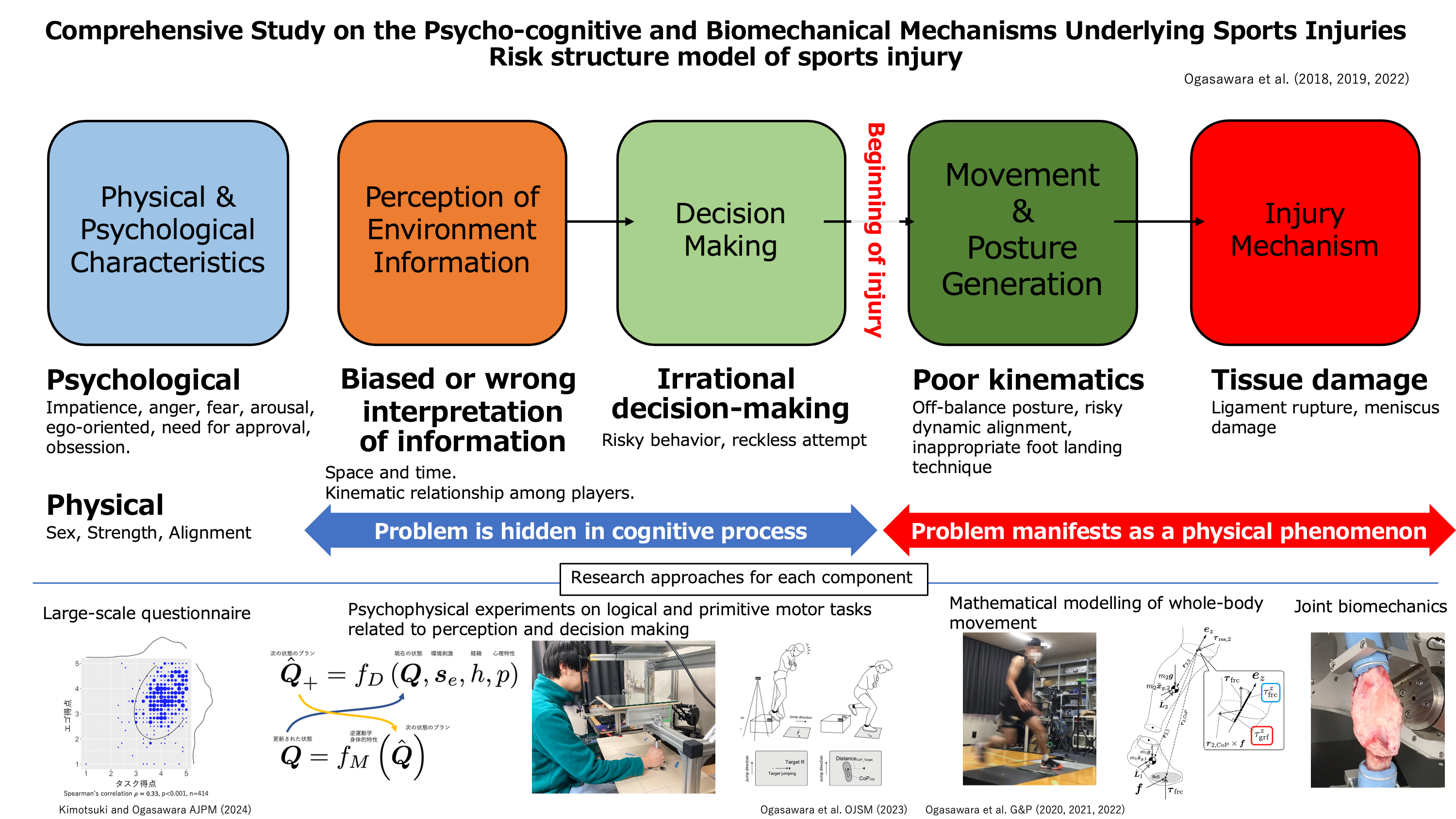
Sports injuries among young athletes are a serious social issue that can affect not only their athletic careers but also their quality of life and productivity in later years. Our laboratory has focused on anterior cruciate ligament (ACL) injuries as a central topic, conducting comprehensive research on risk prediction and prevention (Figure 1).
ACL injuries are common in sports that involve sudden changes of direction or landing movements. Traditionally, biomechanical studies of injury motions have dominated the field. However, we have found that hidden risk factors beyond biomechanics—such as athletes’ psychological traits, perception of environmental information, and decision-making behaviors—play important roles. These factors form a risk chain model illustrated in Figure 1.
Our research has shown that personality traits such as extreme diligence, high need for approval, and pressure from coaches are related to the severity of sports injuries (Ref. 1). Regarding environmental perception, we found that the three-dimensional spatial relationship between players can disturb postural stability and lead to risky body positions (Ref. 2).
In laboratory experiments, we discovered that features representing “landing impact” and “postural sway” from ground reaction force data during single-leg drop landing tests can predict future ACL injury risk. We also found large individual differences in learning the ability to stabilize posture (Ref. 3).
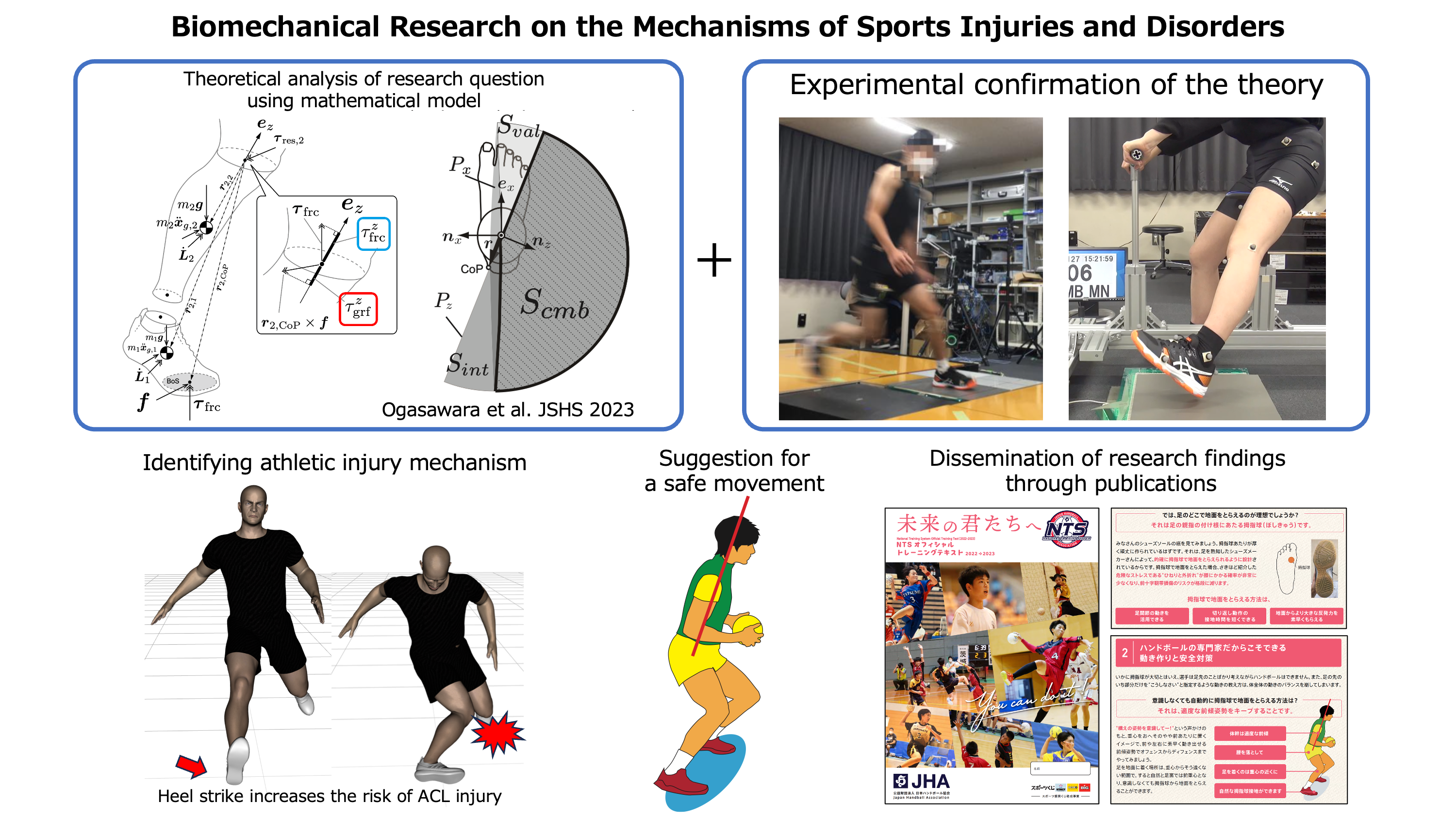
Concerning injury mechanisms, both theoretical and experimental analyses revealed that using the heel to brake during direction changes generates frequent valgus and internal rotation stresses on the knee—identified as a dangerous movement (Ref. 4). Conversely, braking with the forefoot significantly reduces these stresses, and controlling the rotational friction between the shoe and ground can cancel knee torque (Ref. 5). These findings are being widely shared through academic papers and outreach materials for athletes and coaches (Figure 2), aiming to accelerate the prevention of serious sports injuries such as ACL tears.
Significance of the research and Future perspective:
This research addresses the social issue of sports injuries through a comprehensive and multidimensional approach. By deepening our understanding of psychological traits, we can better screen athletes based on their risk tendencies. Insights into cognitive and behavioral characteristics help explain how environmental information and its perception can lead to poor decision-making that increases injury risk. From the biomechanical analysis of injury-related movements, we can propose “safe movement patterns” that reduce joint stress and suggest scientifically grounded training methods to acquire them.
Furthermore, through deductive analysis using mechanical models, we can quantify and probabilistically reduce joint loads and contribute to the design of equipment—such as shoe soles—that decreases joint stress. These layered, risk-reduction strategies are expected to achieve preventive effects beyond traditional localized methods. Currently, this research is being applied in collaboration with national sports federations, elite athletes, and professional teams.
State of Development / Opportunity / Seeking:
・Available for non-exclusive licensing
・Non-exclusive evaluation for defined period (set up for options)
・Collaborative/supportive research
※Seeking
1. Development partner
2. Licensing
IP Status:
WO 2022/085662 A1, WO 2026/140965 A1
Contact:
ipm@uic.osaka-u.ac.jp